— Michael Novakhov (@mikenov) February 8, 2024
Day: February 8, 2024
Bzhania Meets Russian Foreign Minister Lavrov in Moscow https://t.co/jmPlyOtMZb via @CivilGe
— Michael Novakhov (@mikenov) February 8, 2024

Azerbaijan’s snap presidential election has exacerbated an authoritarian conundrum for the incumbent, Ilham Aliyev. In moving to cement his legacy at home as Azerbaijan’s unifier and builder of a modern state, he has inflicted additional damage to his country’s image abroad, as reflected by a deepening feud with the Council of Europe.
Aliyev cruised to victory in a vote February 7 that watchdog groups said was never genuinely competitive. Local observers believe the presidential election was more about Aliyev’s desire to bolster his regime’s legitimacy and solidify his place in the history books than about obtaining a mandate for the future.
Aliyev did not make a secret of his motivation for moving the presidential election forward by a year: he wanted to take advantage of the popular euphoria generated by Azerbaijan’s Reconquista of Nagorno-Karabakh, which Azerbaijan’s military completed in 2023. In an interview with pro-government television channels, Aliyev linked the early election to his “epochal” victory in the second Karabakh war, which he cast as unprecedented in Azerbaijan’s history.
Aliyev appeared to secure his domestic political objective with a convincing margin of victory in the election. The central question moving forward is; what will be the final cost of victory, in terms of Azerbaijan’s international reputation?
The run-up to the presidential vote was marked by what rights activists described as an unprecedented crackdown on independent media and free speech. The chief target of repression was a media outlet, Abzasmedia, which saw many top editors detained. No longer able to work inside Azerbaijan, the outlet shifted operations to Berlin.
“For Aliyev, following the Karabakh victory, securing a win in the presidential election seemed like the final piece in his quest for absolute control over Azerbaijan,” said Leyla Mustafayeva, acting head of Abzasmedia. “His nationalist rhetoric, which had rallied the nation since the 2020 Karabakh victory, was already losing its immediate effect and power, particularly after Armenians were expelled from Karabakh [last year].”
To ensure his desired outcome in the election, Aliyev needed to “shield himself from scrutiny,” Mustafayeva said. Accordingly, the government took action to silence all critical voices inside the country. Abzas’ astute use of social media, including TikTok, made it a particular target of government ire, said Cavid Aga, an Azerbaijani writer and chronicler of social trends.
The crackdown extended beyond independent media that specialized in exposing instances of corruption and other forms of malfeasance. Activists and politicians not in lock step with the government’s Karabakh policies, including Gubad Ibadoglu, were also subjected to harassment and repression in recent months.
“It was a time to clean house,” said opposition journalist Arzu Geybulla, referring to the pre-election crackdown. “You cannot have snap elections in the country when you are still having journalists bravely reporting on corruption.”
Opposition activist Afgan Mukhtarli, a former RFERL reporter who spent three years in prison after mysteriously disappearing from a Tbilisi street and showing up in Azerbaijan the next day, maintained the crackdown has backfired on Aliyev.
“The relentless media crackdown, especially against Abzasmedia, has exposed the regime’s true nature to European institutions that had previously overlooked Aliyev’s authoritarian excesses,” Mukhtarli said. He added that one of Aliyev’s top priorities in the post-election period is likely to be damage control vis-à-vis the EU.
“He will strive to have the outcomes of his presidency recognized,” Mukhtarli predicted. “He will be compelled to make certain concessions and will go to great lengths to return to the Council of Europe.”
In the days leading up to the election, Aliyev showed no signs of backing down in an escalating dispute within the Council of Europe over Baku’s rights record. On February 2, Aliyev threatened to withdraw from several European institutions, including the Council of Europe and the European Court of Human Rights after the CoE’s Parliamentary Assembly indicated it would not recognize the mandates of Azerbaijan’s delegation.
Influential figures within the Council of Europe appear more tired of, than intimidated by the combative rhetoric coming from Baku. Frank Schwabe, a German MP who leads CoE’s socialists, democrats and greens group, characterized Azerbaijan as a classic “dictatorship,” featuring “great repression internally” while being guided by desire to “present a good image to the outside world.”
Schwabe’s uncompromising portrayal of Azerbaijan’s political practices suggests that Aliyev has a challenge on his hands if he wants to mend fences with the Council of Europe.
“We must describe the real situation and not remain silent in the face of the dramatic deterioration in the human rights situation,” Schwabe said in a statement given to Eurasianet, referring to the CoE’s dispute with Baku. “The Parliamentary Assembly of the Council of Europe has made it clear that it does not want to be fooled any further. Azerbaijan is committed to transparency. Being able to see and say what is happening is the task of the Council of Europe. Azerbaijan must make this possible. No ifs, ands or buts.”
https://t.co/i4QooJr3ie – The News And Times Reviewhttps://t.co/O0SIgLVWzM#NewsAndTimes #NT #TNT #News #Times#World #USA #POTUS #DOJ #FBI #CIA #DIA #ODNI#Israel #Mossad #Netanyahu#Ukraine #NewAbwehr #OSINT#Putin #Russia #GRUhttps://t.co/DO5LG3PY4T#Путин #Россия
— Michael Novakhov (@mikenov) February 8, 2024
Alfred Grosser, geboren in Frankfurt am Main, floh vor den Nationalsozialisten nach Frankreich und wurde Wegbereiter und scharfsinniger Beobachter der deutsch-französischen Versöhnung und Freundschaft. Seine Stimme wird uns fehlen. pic.twitter.com/y0lgJTmgdT
— Bundeskanzler Olaf Scholz (@Bundeskanzler) February 8, 2024
Putin and Israeli hostages – Google Search https://t.co/kt9WgoxPw4 pic.twitter.com/TAzpcCCDEz
— Michael Novakhov (@mikenov) February 8, 2024
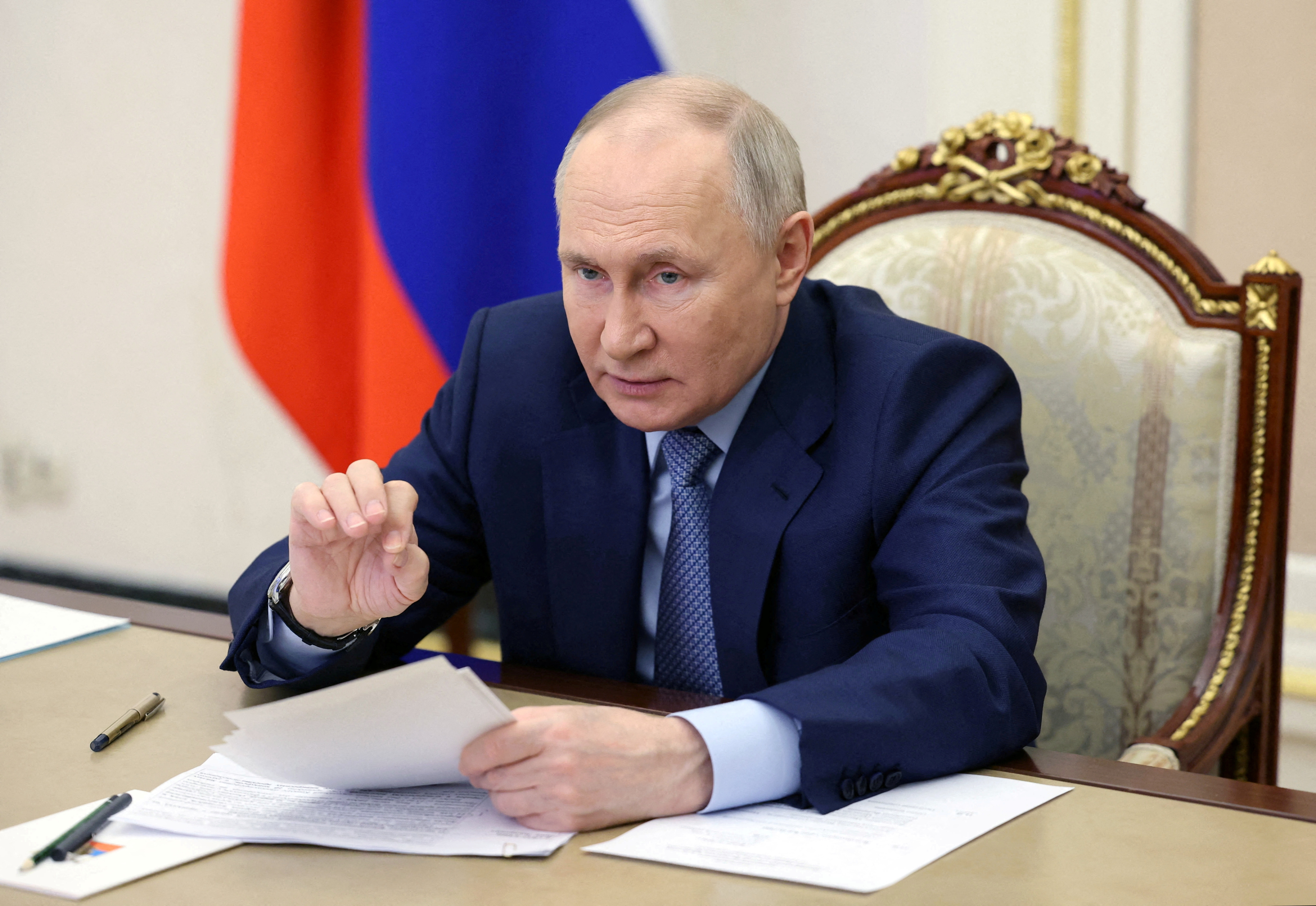
Russian President Vladimir Putin chairs a meeting with government members via a video link in Moscow, Russia, February 7, 2024. Sputnik/Alexander Kazakov/Pool via REUTERS Purchase Licensing Rights, opens new tab
Feb 7 (Reuters) – President Vladimir Putin told leaders of Russia’s Jewish community on Wednesday that Moscow had achieved “specific results” in diplomatic efforts to free hostages caught up in Israel’s conflict with Hamas, Russian news agencies reported.
The agencies said Putin made the comments at a meeting with Russia’s chief rabbi, Berl Lazar, and the head of the Federation of Jewish Communities, Alexander Boroda. Putin said Russia had made use of its contacts with the political wing of Hamas.
“You know, since the situation became more tense in the Middle East, Russia has been doing everything to help people who became hostages,” Putin was quoted as saying.
“As is known, our Foreign Ministry worked through the political wing of Hamas and, on the whole, there have been specific results.”
Putin did not elaborate, according to the reported comments.
Moscow’s efforts, though directed at helping Russian nationals, also sought to help others, the president said.
“They include elderly people and their family members who survived the Holocaust,” he was quoted as saying.
“But I know, I understand, that it is vital to carry on with these efforts. And that is what we are doing.”
Russia, which has drawn closer to Israel’s arch-rival Iran since the outbreak of the nearly two-year-old Ukraine conflict, has restated its support for Palestinian statehood, and criticised Israeli military action in the Gaza Strip.
Moscow also has said the violence in the Middle East is a reflection of U.S. policy failures in the region.
Putin’s reference to Holocaust survivors comes a day after Russia’s foreign ministry told the Israeli ambassador, Simona Halperin, of its “negative reaction” to her criticisms of Foreign Minister Sergei Lavrov and Russian policy.
Authorities criticised her “unacceptable comments” in an interview with Russian newspaper Kommersant in which she said Lavrov had played down the importance of the Holocaust and that Russia was too friendly with Hamas.
Reporting by Ron Popeski
Editing by Bill Berkrot
Our Standards: The Thomson Reuters Trust Principles., opens new tab
https://t.co/JAv0eUTBgt – The News And Times Reviewhttps://t.co/O0SIgLVWzM#NewsAndTimes #NT #TNT #News #Times#World #USA #POTUS #DOJ #FBI #CIA #DIA #ODNI#Israel #Mossad #Netanyahu#Ukraine #NewAbwehr #OSINT#Putin #Russia #GRUhttps://t.co/DO5LG3PY4Thttps://t.co/ze5LKIfHQ4
— Michael Novakhov (@mikenov) February 8, 2024